How much do bridal alterations cost?
Posted on
Alterations! We never think about them when choosing a dress, but in the industry, it is generally accepted that the majority of brides will need some kind of alterations, even if minor. While it can be quite straightforward to budget for a dress, many people forget to budget for alterations. It is also a little bit more complex to plan how much you will spend on your alterations before you have the dress, quite simply because you won't know what needs altering until you find and try the dress. But, here are some things for you to consider on your journey to your perfect dress...
Why are alterations even needed? That's because firstly, unless totally bespoke, dresses are made to specific body shapes, sizes and heights, and it takes a very lucky person to have a body that exactly matches that of the manufacturer's forms. Unlike everyday clothes or even formal wear, most wedding dresses aren't made with stretch material. This makes fitting it a matter of shaping the fabric to you, and not stretching it to your shape. If you've been measured for your dress, it will have been ordered to the closest match possible from the manufacturer. Some suppliers have split size options, which makes the dress a little bit more customisable for a better fit, and can reduce your alteration needs. However, as these services are not totally bespoke, it is still a matter of trying to find the best possible fit for your measurements.
Secondly, it's your wedding day and you definitely want to look like you're wearing a dress that was made perfectly for you so you can move about with grace and exhude gorgeousness and elegance! Tripping over your hem constantly because it's too much underfoot isn't a good look, neither are straps that are too long and falling all the time, big gaps on the back or decolleté, and so on. Every bride wants to look their best on their wedding day, after all, all eyes will definitely be on you.
What are the most common alterations that you might need? By far the most common is shortening of the hem, even if everything else fits perfectly. Shortening of the straps or waist are also quite common alterations, and so is a bust tuck to remove some gaping on the bust. Replacing the zip with a corset back is a popular option when buying a dress that is a little bit small but fits well on the front. Some dresses have a bustle already incorporated in the design, but if you don't have one. have a train and would like to have a way to secure the train up in the evening, then you will need to have one added. These are from my perspective the most commonly seen alterations on well-fitted dresses.
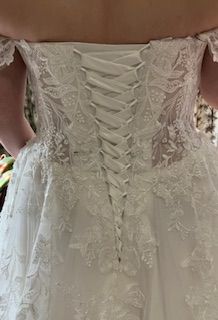 The corset back (left) is one of the most common alterations when the dress is a bit too small but fits well on the front. Dresses with existing corset backs are more likely to fit slightly different sizes so make an attractive option to minimise alteration costs.
And how much would these cost? Here is where it gets tricky. It all depends on the dress style, number of layers, fabric types, complexity of the alterations, and many more. On average, for me, you can expect between £200-£300 for standard alterations, although minor works could be less than £100 and extensive work £400 and over. This could be a lot higher or a bit lower in other parts of the country. Compared to regular clothing alterations, it is a lot more, not because 'it's a wedding dress' but because wedding dresses often have more complex structures, many layers to deal with, and are often made of materials that are difficult to work with. They are also more difficult to handle due to their size and delicate nature of some of the material used. It is quite common for dresses to have between 10-20 hours spent on them, plus there are fitting times that have to be accounted for. At the time of writing, the national minimum wage is over £12 per hour for those over 21 years old. This would be for someone with minimal experience in the industry. Professionals with years of experience will naturally charge more, because they are bringing their hard earned expertise to the table. Independents may charge from £25-50 per hour, while boutiques up to £90 per hour depending on geographical location and whether they need to charge VAT, which is 20%.
What makes alterations more time consuming or complex? (and therefore more expensive) Some features make a dress more time consuming to alter, others make it more complex (and therefore time consuming too). Often people might think that because 'it's only a small amount' that needs to be adjusted for, then it might be cheaper. Unfortunately, there is no difference between a small amount and a regular amount as the same amount of time and work is needed to open a dress up even to take the smallest amount. In fact, in some cases, a small amount is more time consuming than a large amount. To help you assess whether a dress will need minor or major alterations, here are some things to bear in mind when dress shopping when you are budgeting for alterations. Also, it is worth remembering that things add up. So if you only need one complex thing done, it could be cheaper than having multiple but less complex alterations.
- Number of layers: the more layers the higher the cost, because each layer has to be dealt with, normally separately. For example, a dress with only one lining and an outer layer is significantly cheaper to alter than a dress with 3 layers in the bodice and 9 skirt layers.
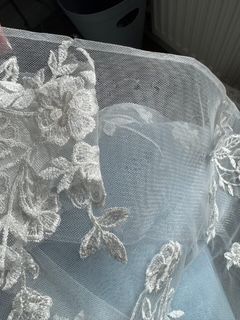 - Hem type: some fabrics in the underskirt can be just cut (the seams are then reinforced so they don't fall apart), but some layers may have horsehair*, which is time consuming to remove and re-attach. If the outer layer has a lace edging, this has to be manually unpicked and re-stitched back after the hem is shortened. If the layer has both horsehair and lace to be unpicked, then it's doubly time consuming and the price will reflect it. If the bottom of the skirt is very wide, as in a very large ballroom style dress, the price goes up as well as it can be metres and metres of fabric that need to be shortened.
The horsehair and lace hem (right) is one of the most time consuming alterations as both the horsehair layer and the lace layer have to be painstakingly unpicked and re-stiched after cutting and finishing the hem off. Sometimes tiny holes are made in the process if the stitches are very small and tight together, and they then need to be covered up with extra lace, adding on more complexity.
- Structural alterations: The majority of wedding dresses have a boned bodice and incorporated padded cups. Sometimes alterations can be done without touching these structural features, but in some cases, for example if you are downsizing a lot or if the cups are too big for your boobs, it becomes a complex and more costly job. Downsizing by multiple sizes on a dress with boning and cups is one of the most complex tasks in the alteration portfolio, so it is worth thinking carefully when considering a dress in many sizes too big due to its discounted rate.
- Textured or delicate fabrics: any embellishment to the fabric makes it more challenging to work with, and therefore more time consuming. Beads and crystals may have to be manually removed before work can be done on the fabric. Lace appliqués generally require some unpicking and hand sewing. Fine lace and fine silks require extra care as they can be fragile. Some fabrics easily snag so extra care is needed when handling the dresses.
- Multiple point alterations: Although it might sound simplistic to say that 'it only needs a little bit of taking in', if this involves taking in at the front bust, back, waist, hips, and waistline positioning, all of this add up if each part has to be tackled separately.
- Features in the way of alterations: pleating, buttons and their loops, appliqués, boning, embroidery, pockets - anything that's in the way and that you wouldn't want to lose, has to be removed first and then replaced. The more a dress has in the way, the more complex the work becomes.
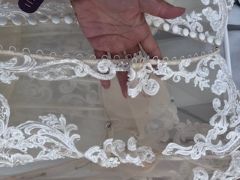 In this back alteration (left), many features were in the way and needed to be removed and re-applied later: buttons, loops for the buttons, reinforcing hook and eyes, lace and even the sheer tulle fabric had to be removed and replaced.
- Design modifications: Alterations generally keep the dress style unchanged, but are intended to make the dress fit better. Design modifications are custom changes in the dress design, and the more dramatic the change, the more hours and fittings are required on the dress. Two common examples of design modifications are to add long sleeves when there aren't any, and creating a slit (or closing a slit when there is one). The former is a significantly more complex task, particularly when the starting base is a strapless dress.
What can you do to minimise your alteration costs? Quite simply, the less alteration you need, the less you will spend, so it makes sense to buy a dress that fits as well as possible. This may mean you actually go and shop around for a different size. But if you have found THE dress, can't find it in any other size anywhere else and it needs work, then, this is it, you will have to either compromise on the fit, the finish or prepare to pay the price. Consider these little tips though:
- Additional padded cups or changing the bust cups if the cups are just a tiny bit too big
- Platform shoes or high heels if the dress is just a very tiny bit longer
- A hooped petticoat can also help in the case of fuller dresses if the hem is just a little on the long side
- Body double sided tape, boob tape and/or shape wear may make the slightest of differences in how a dress fits
- How perfectly fitted would you like to have it? Are you happy to compromise on small things which most people wouldn't even notice?
If your heart is split between two dresses equally, you can save on alteration costs by choosing the one which has less layers, no intricate fabric (or a good fit in the areas where the intricate fabric is) and a better fit, particularly on the bust area.
A few more things to consider for specific styles:
Fitted/ mermaid style dresses, where the dress is figure hugging from the shoulders to the knee: these styles can be costly to alter for those who wear different sizes for their tops and bottoms if multiple points need to be altered (bust, waist and hips).
Tea length dresses are a great way to save on hemming costs as most won't need to be shortened.
Corset backs (lace-up backs) are also a great way to accommodate a little bit more or a little bit less, and are great if your weight tends to fluctuate, so you won't have to worry about being exactly the same shape through all the fittings and until the wedding.
Strapless dresses (which includes off-shoulder dresses) can be a bit of a challenge for heavy busted ladies. To minimise alteration costs, make sure there is sufficient boning to provide the right support and that the dress is snug enough to stay put. Also, make sure that the cup size is right - cups that are too big can be downsized, but while there can be some solutions, there are more limitations on cups that are too small.
Hope that this has been helpful for you! If you would like to share your experience in the comment box below, please don't hesitate!
----------------------------
* Horsehair is a type of stiffening material made with criss crossing nylon type filament which is often placed at the bottom of hems to give them a firm and not floppy look.
-----------------------------
Blue Lily Magnolia does bespoke and alterations for wedding dresses, bridesmaids dresses and other formal attire. Please contact Sharon on 07766766573 or [email protected] to enquire. Whatsapp and email are best as you can share your pictures with me in the conversations, and they also keep all the information together for future references.
Add a comment: